 Think and Growth Back to channel
The 5:1 Ratio: The Math That Predicts Whether Love Lasts
The 5:1 Ratio: The Math That Predicts Whether Love Lasts
Think and Growth · Wednesday, October 7, 2026 · Family Week
Every family has a story it tells itself about conflict. "We just fight too much." "We've grown apart." "It shouldn't be this hard." And every family assumes the verdict is about the volume of the fighting.
The research says otherwise. The verdict is about the ratio.
The Experiment That Watched Love Fail
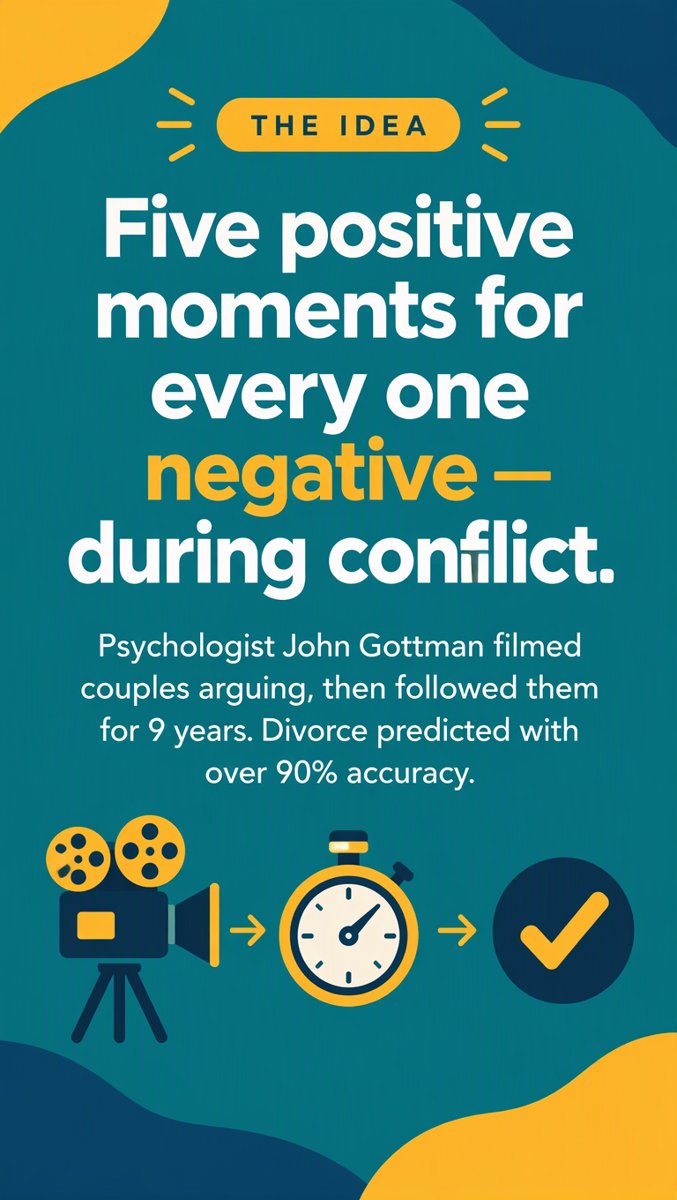
In the 1970s, psychologist John Gottman and Robert Levenson began asking couples to do something strange: sit in a lab at the University of Washington and argue. Fifteen minutes. One real conflict. Cameras rolling. Researchers coded every positive move — a joke, a touch, a nod, a moment of genuine curiosity — and every negative one: criticism, defensiveness, an eye-roll.
Then they waited. Follow-ups at nine years, and later fourteen. The result made Gottman famous: across seven longitudinal studies, his models predicted which couples would divorce with over 90% accuracy — 93% in the 14-year study published in the Journal of Marriage and Family (Gottman Institute; Gottman & Levenson, 1992, JPSP).
The number that emerged from that work is now called the magic ratio: five positive interactions for every negative one, during conflict.
Read that carefully, because most people get it wrong. The ratio doesn't describe how couples behave on a calm Sunday afternoon. It describes what happens mid-argument. The couples who stay together don't fight less. They fight with warmth still switched on (Manhattan Mental Health Counseling).
Why Five? Why Not One-for-One?
Here's the uncomfortable part. If positives and negatives were equal in weight, a 1:1 balance would keep a relationship level. It doesn't — and distressed couples are exactly the ones sitting at 1:1 or worse.
Psychologist Roy Baumeister and colleagues reviewed hundreds of studies for a 2001 paper titled, bluntly, "Bad Is Stronger Than Good." Across nearly every domain, negative events produced stronger, longer-lasting effects than positive events of the same size. Applied to Gottman's finding: bad events in close relationships are, on average, about five times as powerful as good ones. Psychologist Rick Hanson's framing sticks: the mind is Velcro for negative experiences, Teflon for positive ones. The criticism from Tuesday is still there on Friday. The compliment from Tuesday is gone by dinner.
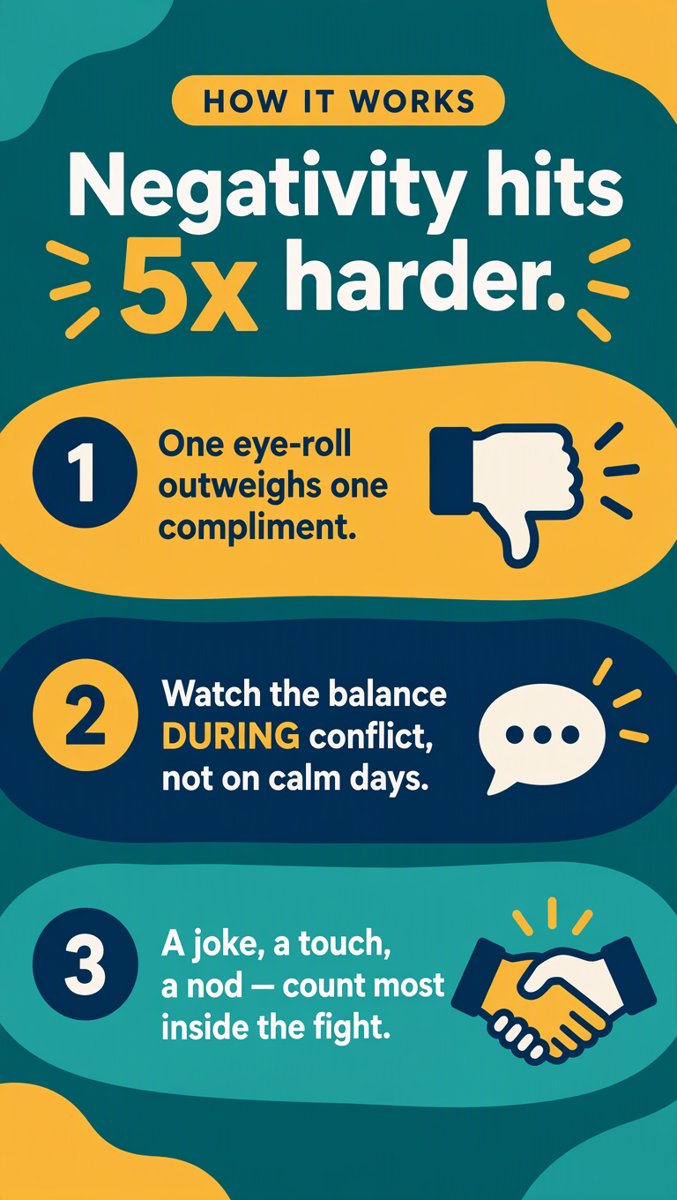
That asymmetry is why the ratio must be lopsided. You're not being sentimental by stacking positives. You're correcting for physics.
What the Lab Actually Saw
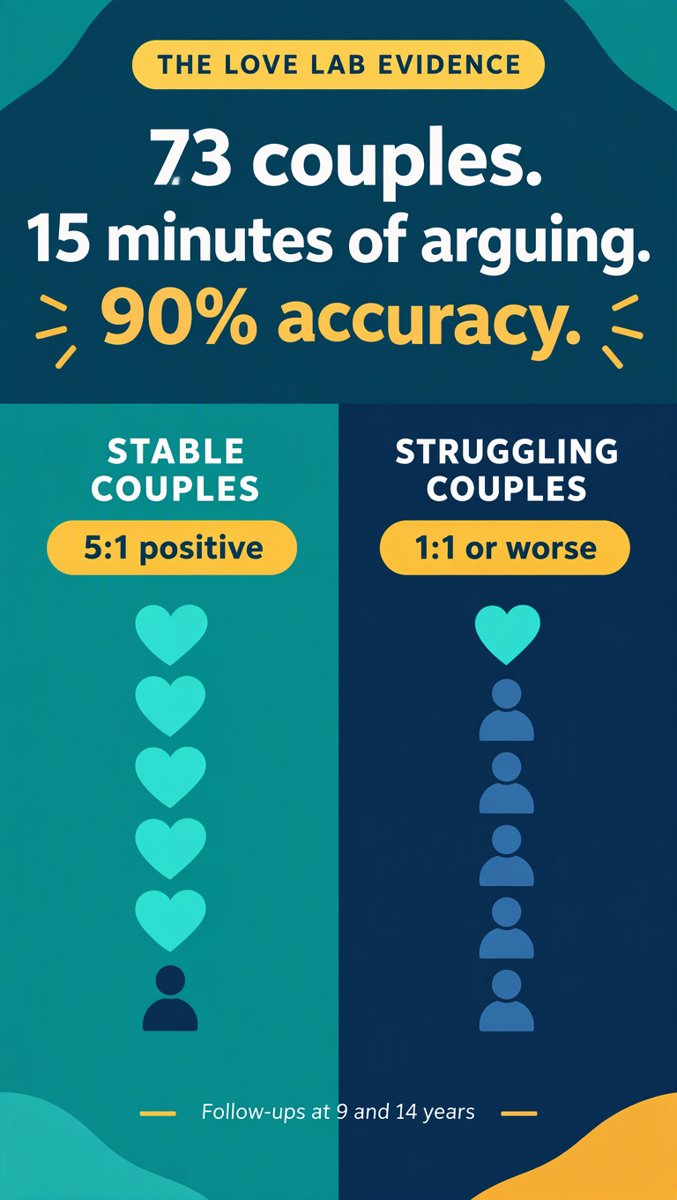
In the 1992 follow-up, Gottman and Levenson sorted 73 married couples by their positive-to-negative balance during conflict. The pattern was stark. Couples who kept the balance tilted clearly positive — laughing and teasing while disagreeing, reaching for each other's hand, saying "we're okay" — stayed together. Couples whose balance collapsed toward 1:1 were far more likely to separate.
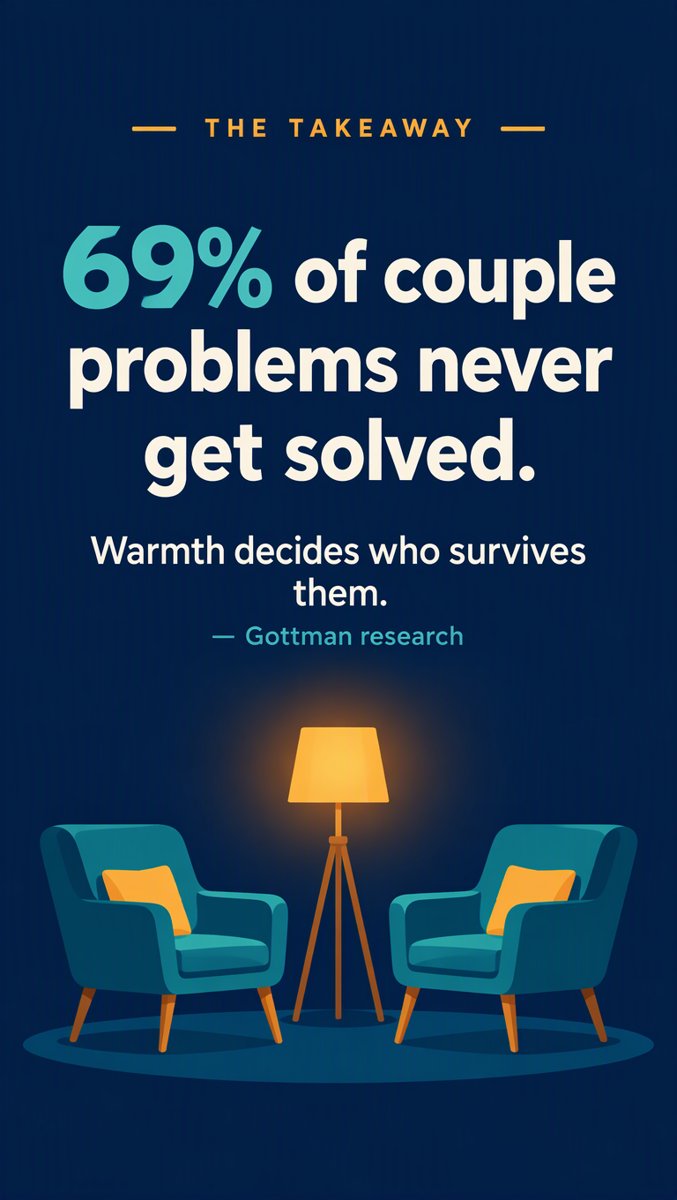
And one more finding that removes a mountain of shame: 69% of relationship problems are perpetual. They never fully resolve, because they're built on durable personality differences. Stable couples don't solve these problems. They learn to talk about them without poisoning the well. That's not failure — that's the job description.
Run Your Own 5:1
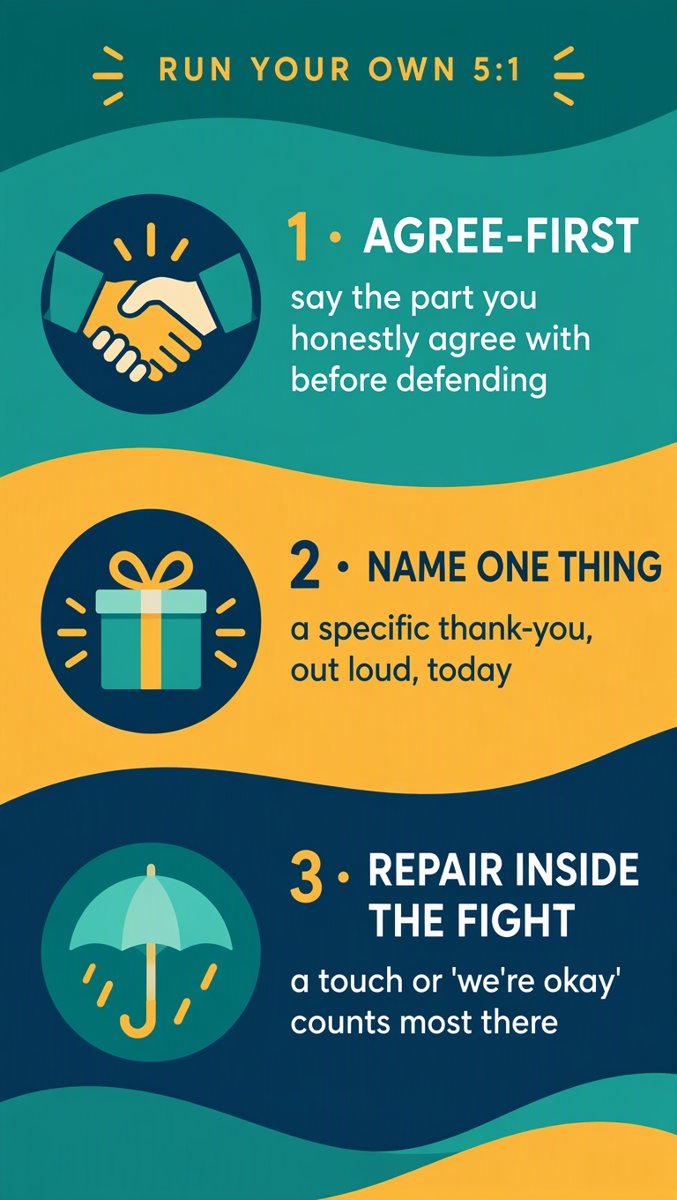
Three moves, starting tonight:
-
Agree-first. Next time your partner raises a complaint, don't open with your defense. Find the ~10% you honestly agree with and say that first. "You're right — I've barely been present since Monday." Pause. Let it land. Then add context. Agreement was one of the exact positive codes Gottman's team counted, and it lands hardest inside the conflict.
-
Name one thing. One specific thank-you, out loud, daily. "Thanks for handling the pharmacy call — I was dreading it." Specific beats general. Out loud beats silently appreciated.
-
Repair inside the fight. A touch on the arm. A bad joke. "It makes sense that you feel that way." These count double precisely because they happen where positivity is hardest to find.
One honest caveat: the ratio is a description from a research program, not a diagnostic test for your marriage. Keep a one-week journal if you're curious — count the small positives you've been missing. You'll likely find the balance was better than the arguments made it feel.
The Takeaway
The families that last aren't the ones that never break a dish. They're the ones that keep a running surplus of warmth — five deposits for every withdrawal — so that when the fight comes, and it will, there's something in the account.
Sixty-nine percent of problems never get solved. Warmth decides who survives them.
Sources
- The Gottman Institute — The Magic Relationship Ratio, According to Science
- Manhattan Mental Health Counseling — Gottman's 5:1 Ratio: Five Positive Moments for Every Negative One
- Gottman, J.M., & Levenson, R.W. (1992). Marital Processes Predictive of Later Dissolution: Behavior, Physiology, and Health. Journal of Personality and Social Psychology.