 Think and Growth Back to channel
Social Penetration Theory: Friendship Isn't Found — It's Layered
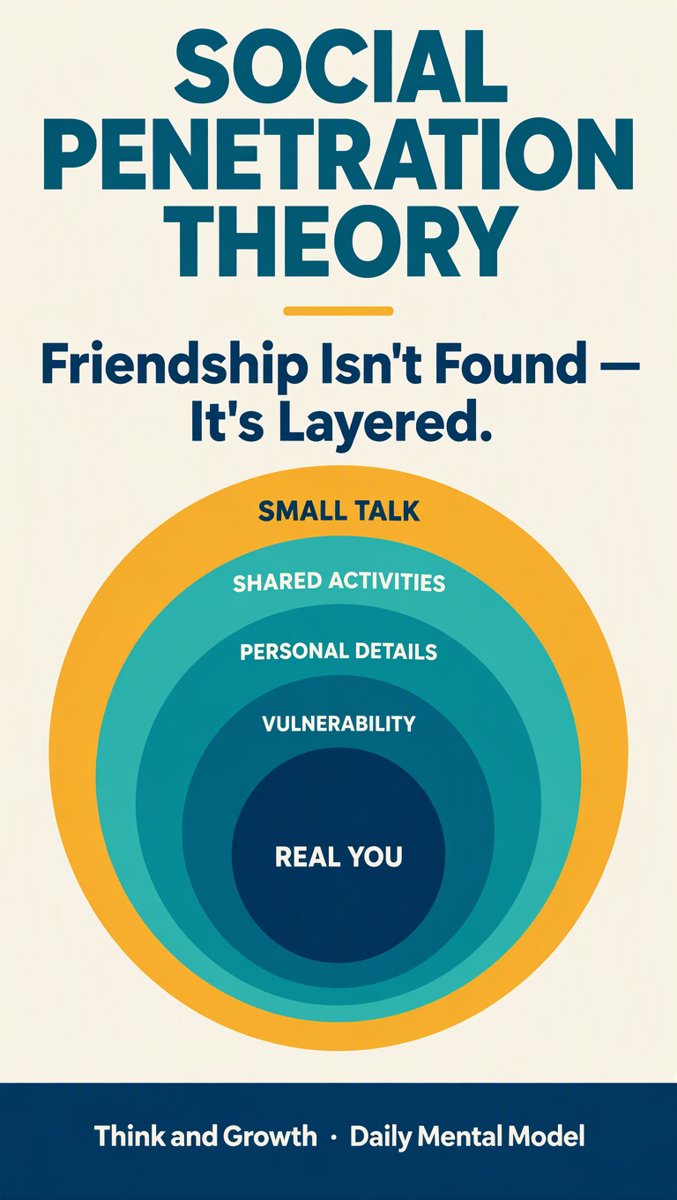
Social Penetration Theory: Friendship Isn't Found — It's Layered
Think and Growth · Daily Mental Model · Saturday, October 10, 2026 Theme: Friendship
The 60-Second Version
Why do some friendships stall at small talk for ten years — while a stranger becomes a close friend in a single evening?
In 1973, psychologists Irwin Altman and Dalmas Taylor answered that question with one of the most durable ideas in social psychology: Social Penetration Theory. Their metaphor was an onion. Every person is layered, and every relationship peels those layers back — slowly, mutually, one disclosure at a time.
Two dimensions drive the process:
- Breadth — how many topics you and someone else actually talk about. Work. Weather. Kids. Money. Fear.
- Depth — how real each of those topics gets. Anyone can discuss their job. Few people can say "I'm terrified I'm going to be laid off."
Most "friendships" that feel stuck aren't stuck on time. They're stuck on layer two.
The Mechanism: Three Moves
1. Start broad and shallow. Every relationship begins on the outer ring: weather, sports, the neighborhood. This isn't fake — it's the safety test.
2. Reciprocate. Altman and Taylor found that disclosure runs on a reciprocity norm. You share a little; the other person matches it; a layer peels back on both sides. Nobody has to auction their soul — both just step one ring inward.
3. Go deeper only as fast as trust grows. Overshoot — unload something deeply personal on someone who hasn't earned it — and people retreat. Researchers call it depenetration: the relationship snaps back a layer, sometimes for good. Undershoot — keep every conversation at the weather for a decade — and you plateau. That's the coworker you've "known" for ten years and couldn't call in a crisis.
The Proof: 45 Minutes
The theory isn't just an elegant metaphor — it's been stress-tested in a lab.
In 1997, Arthur Aron and colleagues ran a now-famous experiment published in Personality and Social Psychology Bulletin ("The Experimental Generation of Interpersonal Closeness"). Pairs of strangers spent just 45 minutes working through 36 questions — each one engineered to escalate in personal intensity, from "Would you like to be famous?" to "Share a personal problem and ask for advice."
The result: pairs in the escalating-disclosure condition rated their closeness dramatically higher than pairs given small-talk tasks for the same amount of time. Forty-five minutes of structured deepening outperformed hours of comfortable surface chatter. UC Berkeley's Greater Good Science Center now uses the same protocol as a practical exercise, noting that the closeness it generates can persist and even become the basis of a real relationship.
Read that again: closeness is a procedure, not a lottery.
How to Apply It This Week
You don't need a lab, a spreadsheet, or 36 index cards. You need three moves:
- Share one true thing. This week, tell a friend something one notch past safe — a real frustration, a real plan, a real fear. Not a trauma dump; one honest layer.
- Match, don't race. When they share, meet their depth. Don't redirect to yourself, don't retreat into a joke, don't sprint two layers ahead of them.
- Add one layer per conversation. Friendship compounds like interest. One slightly deeper exchange per interaction, repeated, and a year from now you'll have a different relationship with the same person.
The Takeaway
Altman and Taylor's quiet insight: intimacy isn't discovered — it's constructed, disclosure by disclosure. The friendship you're waiting to "find" is actually waiting to be layered.
Closeness isn't found. It's layered. One honest exchange at a time.
📝 Narration Script (video, ~73s @ 2.5 wps — 182 words)
[Cover / Hook] Why do some friendships stall at small talk — while others turn into family?
[Slide 1 — The Idea] Psychologists Altman and Taylor call it Social Penetration Theory: relationships deepen like peeling an onion. Two dimensions matter: breadth, how many topics you share, and depth, how real each gets.
[Slide 2 — How It Works] Every relationship starts broad and shallow: weather, work, sports. Trust grows through reciprocity — you share a little, they match it, the layer peels back. Go too deep too fast, and people retreat. Too shallow too long, and you plateau.
[Slide 3 — Real-World Example] In 1997, psychologist Arthur Aron tested this with strangers. Pairs spent just 45 minutes answering 36 questions, each one more personal than the last. They rated their connection dramatically higher than pairs stuck doing small talk.
[Slide 4 — How to Apply It] Want closer friends? Trade information, not time. Share one true thing this week — something a little past safe. Then match their depth, and go one layer deeper each conversation.
[Slide 5 — Takeaway] Closeness isn't found. It's layered — one honest exchange at a time.
[CTA] That's today's model. I'm Peter — follow Think and Growth for one practical mental model every day. See you tomorrow.
🎬 Per-Segment Clip Text (subtitle-fit: ≤15 words / ≤6s per clip)
| # | Image | Segment | Words |
|---|---|---|---|
| 1 | cover | hook | 12 |
| 2 | slide-1 | idea seg 1 | 14 |
| 3 | slide-1 | idea seg 2 | 15 |
| 4 | slide-2 | mechanism seg 1 | 10 |
| 5 | slide-2 | mechanism seg 2 | 15 |
| 6 | slide-2 | mechanism seg 3 | 15 |
| 7 | slide-3 | example seg 1 | 9 |
| 8 | slide-3 | example seg 2 | 15 |
| 9 | slide-3 | example seg 3 | 12 |
| 10 | slide-4 | apply seg 1 | 8 |
| 11 | slide-4 | apply seg 2 | 12 |
| 12 | slide-4 | apply seg 3 | 11 |
| 13 | slide-5 | takeaway | 12 |
| 14 | cta | CTA (fade_out) | 19 |
Total: 182 words ≈ 73 seconds. Motion: none on clips 1–13; fade_out on CTA (clip 14). Subtitles: "none" on all clips — cards carry their own text.